Table of Contents
Introduction
Paul, an apostle, apostle not of men, neither by man, but by Jesus Christ and God the Father who raised him up who was dead in the trespasses of his sins, expeditiously addresses the issue of another gospel. This “Another gospel” persistently invades the territory of grace and liberty with heavy shackles and chains of ordinances that were meant to reprise lack and not fulfillment. And wherever the Gospel of liberty is preached, the masters of the law seem to invoke an injunction of covenant keeping upon all made free by Jesus Christ. And Paul is quite familiar with this injunction and made great strides addressing the issue of a particular work of covenant keeping in his letter to Romans. He expounded on its purpose, inability of man to keep it, and its symbolic fulfillment in Jesus Christ, and its state of redundancy.
Another gospel that Paul refers to here is the gospel of justification by works of the law and not by faith. He has been made aware of the reverting of the faith of Galatians from the Gospel of justification by faith in Christ to faith in the works of the law. He observes that they have been charmed into going back to keeping circumcision laws of the Jews for salvation rendering the gospel of Christ of none effect.
He emphasizes and magnifies the devious error of departure from being perfected by the Spirit to being perfected by the flesh. The Jews who stand in contention with Paul’s message seem to have vigorously tarried proselytizing even those that are in Christ, the gospel message of works of the law. The very works that were intended to bring about the knowledge of sin and not knowledge of righteousness or the means to achieve the whole of it in letter and in spirit.
Paul, at the beginning of the letter mentions a distinction without a difference and that is he is committed the gospel of uncircumcision while Peter is committed the gospel of circumcision. Peter was to preach to those of the circumcision, the fulfillment of the covenant of works in Jesus Christ; and Paul to preach to those of the uncircumcision, their adoption as sons and daughters of Jehovah through faith in Jesus Christ.
This signifying, that the unifying Gospel message of Jesus Christ proclaims the same freedom and liberty and grace to both the circumcised and the uncircumcised. He makes it evident to them that whether the Gospel is preached by Peter or Paul, it is the same Gospel of liberty and not of bondage. And Paul says, should anybody or even an angel preach any other gospel then let him be accursed.
To make attempts to reverse the adoption of sons and daughters to appropriate illegitimacy is to bring cosmic reproach to the redemptive work of the Cross of Calvary. To revert to justification of faith by works is to argue against the adopted status of the believers in Jesus Christ. It is no light matter that Jesus said, “and when he is made (proselytized) ye make him two fold more the child of hell than yourselves” in Matt 23:15. It is woeful! But, should faith remain without works? That is an entirely different subject matter which can be discussed purposefully on matters that pertain to the fruit of the Spirit and its corresponding works.
And Paul, in order to expound on this more to his readers, past and present, he traces his steps back to Biblical history of the life of Abraham and Sarah, and Hagar. Paul speaks of Abraham and Sarah as those that are free and unto whom Grace, Promise, and The Covenant was given, while Hagar was merely a woman of bondage inheriting nothing of the Promise and The Everlasting Covenant that was given to Abraham.
By doing this, he emphasizes the Theological and Soteriological significance and all the symbolism, typology, and foreshadowing of the salvation that was wrought through Jesus Christ in and through all of the Biblical events. These events are not just things that happened to chronicle them in the annals of history but to ponder over the works of God through human history. And Paul, moved by the Holy Ghost takes his readers back to the first covenant that God made with a man named Abraham and his entanglement with the bondwoman named Hagar and the resulting consequence.
What I will attempt to do here is take Paul’s hint and go back to the very beginning of Abraham’s life and draw out from the texts the fruits of leaning on human wisdom as opposed to leaning on the promises of God. To see what the works of the flesh avail as opposed to the work of God.
The principle that I lay the foundation of this methodology is found in Galatians 6:8 –“For he that soweth to his flesh shall of the flesh reap corruption; but he that soweth to the Spirit shall of the Spirit reap life everlasting.”
The Two Covenants – Abraham and Hagar
Hagar, an Egyptian, through fortuitous circumstances finds herself in the lives of Abraham and Sarah. Unbeknownst to her, she is now part of an incredible journey charted by God himself to give her master, Abraham an inheritance incomprehensible through her mistress, Sarah. And in this context, her life is immediately juxtaposed with the life of Sarah – bondwoman and freewoman. Unto Sarah belongs the Promise of God but unto Hagar, an obligation of decrees and duties to perform.
Her entrance into the Biblical text and Biblical History in Genesis 16 is directed through a period of famine, personal will against God’s will, a lie of omission, and unintended but well purposed consequence of her being sent away as a handmaid to Sarah while she abode in the prosperity and supply of sustenance in Egypt.
The period of famine as we read in Gen 12:10 is ordained and timed by LORD GOD in conjunction with his calling of Abraham out of his country, from his kindred, and from his father’s house into a land (Canaan) that God would give for him and his seed. The seed here is singular pointing to Jesus Christ through whom his descendants would be as innumerable as the stars in the sky. (Gen 12:1-2, 7; Gen 15:5, Gen 22:17, Gen 26:4). God’s words spoken shall not return to him void. Neither is God a man that he should lie (Numbers 23:19). The covenant made by God stands forever. It is an everlasting covenant as we read in Isaiah 55.
Now, how does Abraham respond to this? He does believe God and does as he says and follows where God leads him and God counts unto him for righteousness for he believed and obeyed. That is until the world and his journey is accosted by severe famine in the land that was grievously detrimental to all the living. In his moment of dire need and the desire to preserve the self taps into personal agency and human wisdom to seek refuge in a land that God did not command him to go.
What we are given to see here is that we are creatures who forget. And we not only forget but turn to our own understanding when there is lack of clarity and direction instead of trusting in the LORD (Prov 3:5-6). And in so doing, we end up walking contrary to God’s commands. And here, Abraham seems to have forgotten that the LORD GOD bound himself in the covenant that he initiated and made with Abraham making it necessary for him to bless and provide for Abraham’s family.
Though I would detest saying this, but in some sense it becomes obligatory for God to keep the covenant by sustaining the lives of Abraham and his family. I would attribute the obligation here to LORD GOD’s loving kindness and tender mercies. Also, that God is not a man that he should lie; neither the son of man, that he should repent: hath he said, and shall he not do it? (Num 23:19).
We almost immediately see the consequence of leaning on human wisdom while partaking in fulfilling God’s covenantal promise. The result is fear of men and self preservation. And in order to appease men we make accommodations for compromise. We do not lie but lie partially but lie nonetheless to safeguard our own.
And we read in the letter that Paul rebuked Peter for the reason that he sought to please those that were of the circumcision by refusing to fellowship with those that were of the uncircumcision. The implication was that Peter was drawing a distinction between the two preferring justification by works over faith. Preferring bondage over freedom, he pretended to be a Jew while living after the manner of the gentiles.
Now, because of the wandering away from God’s direction, Abraham decides to flee to Egypt for security and shelter. And in so doing he puts Sarah at harm’s way and in order to mitigate the risk lies to the Pharaoh by making it seem that she was just his sister and nothing more. When in truth she was his half-sister and his wife. He does this so that his life may be preserved (Gen 12:11-13). Forgetting again that If God made the covenant with him then he would most certainly preserve them both. Now, this is not to berate Abraham for what he did but to once again demonstrate how through human wisdom in the flesh it is not possible to either obey God or please him. And corruption follows.
Grievous plagues ensue on the house of the Pharaoh. And Abraham instead of being a blessing turns into a curse. Pharaoh then quite dismayed by Abraham sends him and all that he had and was given to him away from Egypt. And in this parting, it is believed that Hagar was given to Sarah as a handmaid. And here begins the life of Hagar, bondwoman with her mistress Sarah, a freewoman.
Two covenants juxtaposed – the covenant of bondage and the covenant of liberty.
Hagar, a woman of bondage of works to fulfill the duty of a handmaid (Law), and Sarah, a freewoman to fulfill God’s covenant (Promise) through Abraham. The Law binds whereas the Promise makes us free because of its fulfillment.
To recapitulate, so far we have the following:
- Abraham is called out of his family, kindred, and country into a land that God promises to give
- God makes a covenant with Abraham and through him and in his seed (singular) the nations of the earth shall be blessed
- Abraham follows God’s direction to go to the land of Canaan
- Abraham shifts his focus from trusting God to keep him alive to trusting himself
- Abraham wanders away from God who made the Promise and flees into Egypt, a place where circumstances lead to bondage
- Abraham deceives the Pharaoh and plagues ensue on the latter and on his house
- Abraham and Sarah part from Egypt inheriting a bondwoman (bondage)
The Son of Bondage and The Son of Promise
Abraham is now a little older than 75 years and Sarah is well beyond child bearing years at approximately 65 years of age. And still no sign of an heir. No sign of the child of promise through whom all the nations of the earth shall be blessed. Called out during a time of famine and now well past child bearing years, an odious cloud of hopelessness looms large. Anxious cares takes over a troubled soul relegating the promises uttered by God ineffectual.
Ten years or so seem to have passed of trying to bring this heir into the world but to no avail. Sarah who was Sarai at the time, growing in frustration resolves to lean on her own understanding, and gives her bondwoman to Abraham so that she may have not one but several children through her (Gen 16:1-3). One might easily miss the fact that this has now turned from staying on God’s strength, assurance, and blessing to fulfill his purpose for his own glory and name to relying on the human works to please not God but herself so that her status in the presence of the bondwoman is fortified and protected.
And so Sarah relies on the woman of bondage and pleads to Abraham who was Abram then to take Hagar for a wife and bear her children. And Abram no sooner than he had just partook in the signs of assurance demonstrated by God to bring about an heir and an incalculable inheritance through his seed (Gen 15), turns to the bondwoman and obliges Sarah and goes in unto Hagar.
Hagar, a bondwoman, conceives the same year she is given as wife to Abraham. And this makes her despise Sarah all the more for her barrenness and incapacity to bear a child. And Sarah, when she thought her reliance on the works of the flesh through human wisdom would bring her peace brought her envy, frustration, and dishonor instead. And Sarah was despised (Gen 16:5). This is the very first time the word, despised is used in the KJV. It means to treat with contempt, or dishonor or to make one a curse.
Ishmael is born about a year after Abraham took Hagar to wife. And when Abraham was ninety nine years old, God makes a covenant of circumcision with him and Ishmael is also circumcised at the age of thirteen. The significance of circumcision is consecration unto the LORD GOD. It is set apart as sacred and holy. So, even the fruit of the bondwoman is also set apart for the glory of God.
Ishmael’s circumcision is covenant of the circumcision of the flesh. This is symbolically referred to in Paul’s letter to Galatians in chapter 4 verse 23.
And then right in the midst of all this turmoil, hopelessness, and barrenness, the LORD GOD speaks to a hundred year old Abraham and says that he will bless Sarah who is ninety and give him a son. Abraham responds by falling on his face laughing hysterically (Gen 17:15-17). And Sarah too laughs inwardly (Gen 18:9-13). Surely, this seemed absurd and comical to them given that almost fourteen years had passed since Hagar conceived and there seemed no hope other than the covenant of the flesh for an heir to bless the nations of the earth.
But unto LORD GOD it was exactly at the fullness of time that he reminds and assures and blesses Abraham establishing an everlasting covenant with him and for the seed after him. And then beyond anybody’s wildest imagination, at the set time, miraculously, Sarah conceives and finally brings forth the promised child, Isaac.
Isaac, a befitting name given the circumstances which means, laughter (Gen 21:1-3). This is no light feat by LORD GOD. This is the supernatural work of God brought about and nothing is too hard for the LORD GOD (Gen 18:14). And Isaac was circumcised on the eighth day as God had commanded him.
Isaac’s circumcision is the covenant of circumcision of Promise (Spirit). This too is symbolically referred to in Paul’s letter to Galatians in chapter 4 verse 23.
When Isaac was about 3 years old, he was weaned from Sarah. And she observes a conflict brewing when she observes Ishmael bullying and mocking Isaac and then makes an appeal to Abraham to cast out the bondwoman, Hagar and her son. For the works of the flesh and the fruit of it cannot be heirs with the fruit of the promise.
What follows in the history of Jacob, Joseph, and his brothers is that same pattern of divine provision in the time of famine through judgment, bondage of their descendants for 430 years and then rescue out of Egypt through supernatural acts of redemption.
Now let us recapitulate the following:
- Sarah turns to dependency on her own will and gives Hagar, the bondwoman to wife for Abraham and he accepts the intervention of the work of bondage
- Hagar despises Sarai. The bond despises the free
- Hagar brings forth Ishmael and he is circumcised
- God reminds, blesses, and assures Abraham and Sarah of a child to be born
- Abraham and Sarah are blessed with a child, Isaac. Sarah is made to laugh
- Ishmael mocks Isaac. The fruit of bondage mocks the promise fruit of the free
- Hagar and Ishmael are cast out as children of the bondage cannot be co-heirs with the children of the promise
The Implication
The implication here is that by leveraging human wisdom in all its ingenuity we cannot usher in the promises of God and salvation in Jesus Christ. Neither can we fully meet the demands of the law when we utterly and miserably fail to understand its purpose and that is to bring to our attention knowledge of sin (Rom 3:20). And those that are under the law ought to in fact place their hands on their mouth and stop their speech because they are guilty before an all righteous God (Rom 3:19).
But if we strive to keep the law then we ought to keep the whole law. And if we fail to keep even one commandment then we have failed the whole law (James 2:10). The presupposition that Paul addresses implicitly here is that one ought to be as righteous as God himself to fulfill the law; the law which came from God who alone is righteous.
But Paul while addressing the same contention in his letter to Romans says that there is none righteous. No not one. There is nobody that understands and there is nobody that seeks God. For us to seek God is to seek him through the law. But our predicament is that we cannot fully understand the law. If we did understand the law then we would seek God through repentance because of our sin. But we do not understand the law. How then can we seek him? Our qualification is that we have fallen short of the glory of God. The rationale of justification of faith by works is trying to fulfill the fullness of the glory of God by something that is short of it.
Paul’s letter to Galatians is in effect a summary of the contention of circumcision that he addressed in his letter to Romans. The contention is that the Jews placed circumcision at the highest order of importance as a sign of belongingness to God. They failed to realize that God made a covenant with Abraham while he was yet uncircumcised. And Abraham received the sign of circumcision as a seal of righteousness of the faith he had even before he was circumcised (Rom 4:11).
God counted unto Abraham righteousness not because he was circumcised but because he believed even when he was uncircumcised. Likewise shall all those that are uncircumcised be counted righteous because of their belief and faith in God. And this imputation of righteousness to the gentiles incorporates them under the same promise that is offered to the Jews.
Abraham then is not only a father to those that are circumcised but also to those that are uncircumcised (Rom 4:12). If we are then his children then are we also the children of the inheritance of the promise – Jesus Christ. And that inheritance is life everlasting. And that is not the result of sowing in the flesh but sowing in the Spirit. And that is also not the result of man meeting the demands of the law in letter and in spirit but in Jesus Christ who meets them all.
The inheritance of the promise came not through the law but through the righteousness of faith (Rom 4:13). Circumcision then is a sign of acceptance. It is not a means to an end but the end itself. God made a covenant of circumcision with Abraham because he was a Jew inward and was accepted by God. One is made Jew not by circumcision of the flesh but by circumcision of the heart in the spirit. God counted his uncircumcision as circumcision because of his faith and obedience (Rom 2:26-29).
And to address this contention in his letter to Galatians, Paul draws on historic symbolism of the covenant that God made between himself and Abraham and the absence of one with Hagar and her son.
The issue of legalism as pertaining to the law underscores the question, “What makes people the children of God?” And Paul gets to the heart of that contention and addresses it head on by asking Galatians if they were made children of God by being perfected in the Spirit through faith or by the law. And if begun by the Spirit then are they now perfected by the law. (Gal 3:2-3).
What then of the law? Paul says that it was added because of transgressions until the promised seed should come to redeem us all from the curse of the law because we are all in sin. The revelation of the promised son brings to us faith that rescues us from the curse of the law (Gal 3:22-23). So, this law then does not work contrary to the law but in harmony with it. Without the law, there is no sin, if there is no sin, there is no need for the Promise. But, the promise was made, and the law tells us why, and the promise of faith of Jesus Christ is given to them that believe. (Gal 3:21-22).
What we have before us then are two paths. One is, Abraham to the Promise to Jesus Christ to Everlasting Life. The other is, The Law to slavery to eternal condemnation.
What makes this contention so severe as to warrant a vigorous attack by Paul against the gospel of works is the persistence of the Jews to impose Law where there is Promise. And therefore, rejecting Jesus Christ who is the seed of Abraham in whom all the nations of the earth are blessed. Ergo, they make themselves to be the way to become children of God. But Paul is quick to warn his readers that if we choose to do this then we are not the children of the free but children of the bondwoman, Hagar.
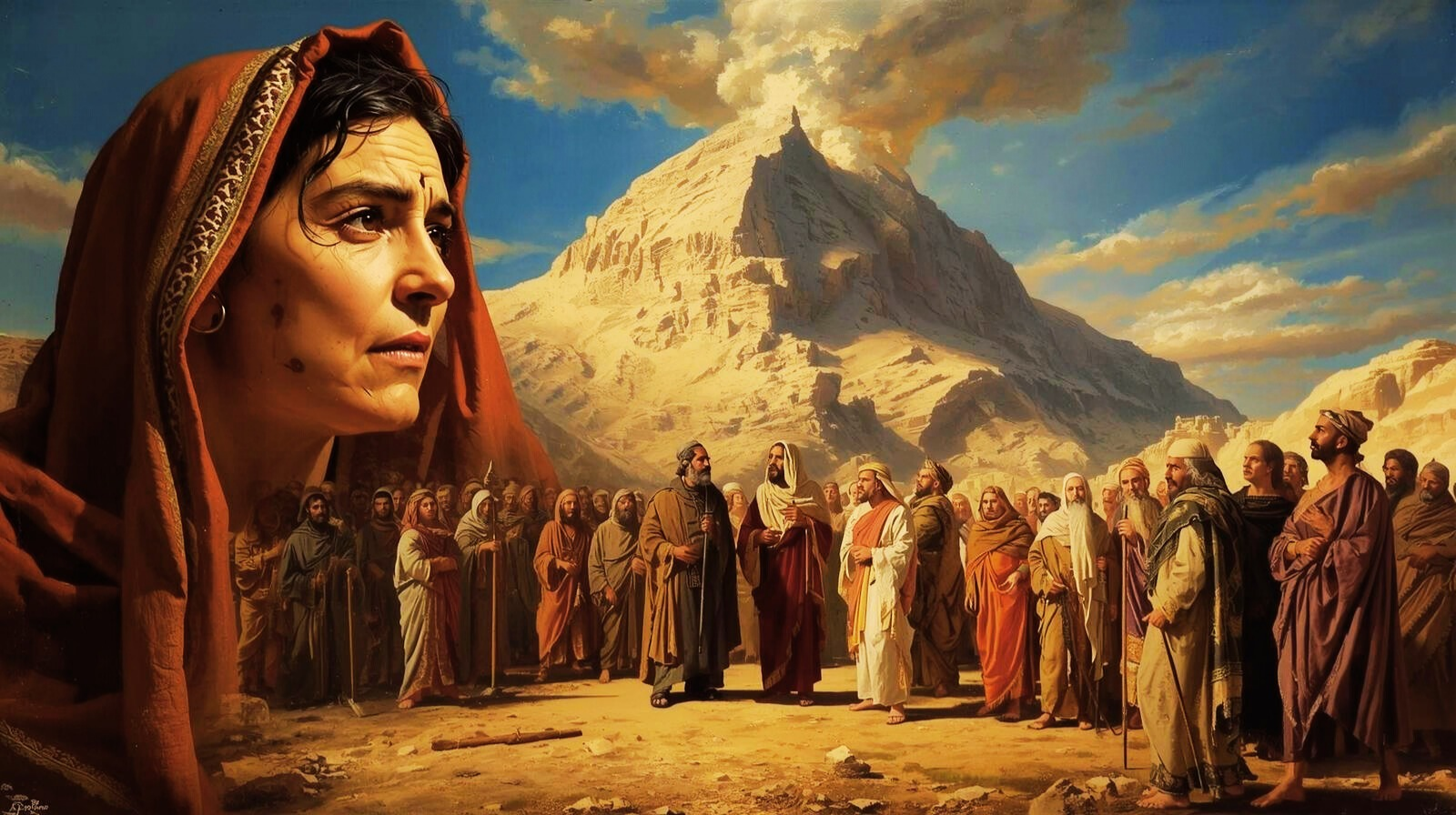
Hence, why Paul symbolizes Mount Sinai where the law was given as Hagar and Sinai as slavery. And what it points to is an earthly Jerusalem where the Jews strive in slavery to meet the demands of the law and what it does is just bring their transgressions and sins to their attention and they are under the yoke of the law.
So, when the Jews draw themselves and others to the law, they transform them back into children of unbelief. They make them children of wrath for the law works wrath. They make them children of the law and therefore bondage to the law. They are then no longer the children of the freewoman but children of the bondwoman.
And in order to partake in the inheritance of Abraham, they need to go through Hagar which is Mt Sinai. They need to go through bondage. They need to go through works of the flesh. But the inheritance was not through works of the flesh but through promise. It was not through the law but through faith.
But where there is law there is no inheritance through promise but slavery to works. And so Hagar (Mt Sinai) reminds them of their insufficiency and their constant missing of the mark of righteousness and their bondage is set in perpetuity.
And why is that? The answer lies in the story of Hagar and Sarah. Why did Hagar despise Sarah? Is it not because Sarah was barren and beyond her capacity and ability to fulfill the promise? Was it not to remind her of her insufficiency?
But for those who wait on The Promise, laughter is brought to them. And this is the admonition we read in Galatians 4:21-31. And just as Ishmael who was born after the works of the flesh persecuted Isaac who is born of the free, after the Spirit, so do those by the works of the flesh trying to please The Law persecute those who are partakers in the fulfillment of The Law in the Promise of the only begotten Son, Jesus Christ.
That which is born of the flesh is flesh; and that which is born of the Spirit is spirit (John 3:6). If the Son therefore shall make you free, ye shall be free indeed (John 8:36).
The admonition by Apostle Paul here is for us to go back and recognize these patterns that have been set out for us by God and realize that if after being redeemed by Jesus Christ and set free, if we go back to the works of the flesh then we are making ourselves the children of Hagar, Mount Sinai, The Law, and not the children of Promise, The fulfillment of The Law.
We would be going back to the covenant of the circumcision of the flesh trampling and annulling as it were the covenant of the circumcision of the Spirit.
And for this reason, Christ was crucified outside of Jerusalem so that he may redeem those under the curse of the law. And transform them from the children of the bondwoman to the children of the free, from the covenant of the circumcision of the flesh to the covenant of the circumcision of the Spirit.
And bring us back from fleeing from The Law which is the covenant of Bondage because of Sin to abiding in the inheritance of the covenant of Freedom through faith in Jesus Christ. It is because of his righteousness, we are redeemed from being trapped in the bondage of earthly Jerusalem to the heavenly Jerusalem which is free.
And this is not to conclude that The Law is inherently bad, but to simply point to our lack because of sin. No matter how convinced Sarah was that Hagar would bring her joy the reality of it was strikingly opposite. Despising, shame, and dishonor was her reward for relying on her own flesh. And so is the reward for those who strive to go to God through The Law (Gal 3:10, 21).
And Paul is also careful to say that The Law then is our schoolmaster to bring us to faith in Jesus Christ. The Law is meant to teach us of our lack, to help us see our bondage to sin and the corruption of the flesh, and to look for The Promise to make us free (Gal 3:21-24).
And just as we read in Galatians chapter 3, if we are the children of The Promise, then we are Abraham’s seed indeed and heirs according to the promise.
Conclusion & Application
What we can conclude therefore is simply this, whether we are Jew or Gentile, we are under the Law of Liberty and not under the Law of Bondage. Even though Hagar’s son Ishmael was circumcised, it was the circumcision of the flesh. But when Isaac was circumcised, it was the circumcision of the Spirit. The Law decrees and the Promise fulfills.
For those who are under the circumcision of the flesh, they answer to earthly Jerusalem and their striving to meet the law never ceases. But those who are of the circumcision of the Spirit, they are the children of heavenly Jerusalem which is free for all of their striving to keep the law has ceased because it is fully met in Jesus Christ.
Therefore, we must cast out the works of the flesh and its fruits, cast out the bondwoman and her son, lest you should be despised and be found reproachful in her sight and be mocked by the fruit of her bondage. We must die to the law and live to God. If we are crucified with Christ in the flesh and resurrected with Him in Spirit then we cannot go back to the baptism of the flesh and make circumcision of the flesh the way to the Law, to LORD GOD. For that is to stand condemned at the foot of Hagar, Mount Sinai as children of bondage for all eternity.